There is a particular kind of clarity that comes from working with your hands for twenty years. Not the clarity of having all the answers, but the clarity of knowing exactly what good work feels like — and being unable
to settle for anything less.
Paulo Ricardo Goncalves spent two decades in the electrical industry. He wired buildings, solved problems in real time, and learned a discipline that most people never acquire: patience under pressure. When something goes wrong inside a wall, you cannot rush it. You cannot guess. You trace, you test, you fix — and you do it right, because the alternative is unacceptable.
When Paulo walked away from that career and picked up woodworking tools, he brought all of that with him.
Reading the material
Paulo works from his workshop in Nigel, Gauteng, where Highveld light comes in flat and honest — the kind of light that shows you exactly what you are working with and gives you nowhere to hide.
He describes his approach to wood the way an electrician describes a circuit. The grain has a direction. The timber has a nature. Your job is to understand it, work with it, and never fight it. Force the wrong thing and you will know about it — either immediately or later, which is worse.
Every piece Paulo makes begins with time spent simply looking. Reading the wood. Understanding what it wants to become before a single cut is made. This is not a romantic affectation — it is the same diagnostic instinct he used for twenty years in trade, applied to a different material.
Where wood meets resin
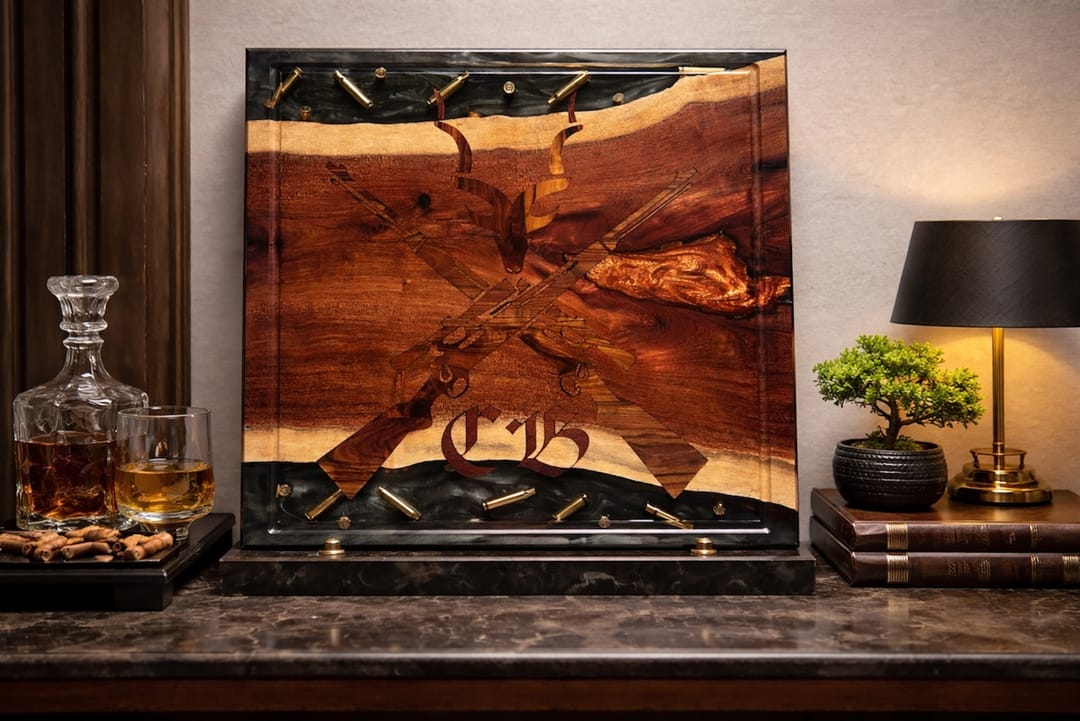
Paulo's signature work sits at the intersection of natural timber and poured epoxy resin — two materials that behave in entirely opposite ways and require entirely different skills to manage. Wood moves. It breathes with temperature and humidity, expanding and contracting over years. Resin is rigid, precise, and unforgiving of error once it sets.
Getting them to live together in a single piece without cracking, warping, or separating requires an understanding of both materials that only comes from doing it wrong enough times to know what right looks like.
His wood and epoxy clock — one of his most recognised pieces — is a working example of this. The natural timber face, with its raw grain and organic edge, is framed in cast black epoxy with ornate detailing. Roman numerals. Hands that move over a surface that took days to prepare. It sits on a wall and looks like it has always been there — like it belongs.
That sense of belonging is not accidental. It is the result of someone who understands how spaces feel, how objects read in a room, and how the relationship between a handmade piece and the person who lives with it develops slowly over time.
The ocean cutting board
Among Paulo's pieces, the ocean cutting board tells perhaps the most complete story of how he works.
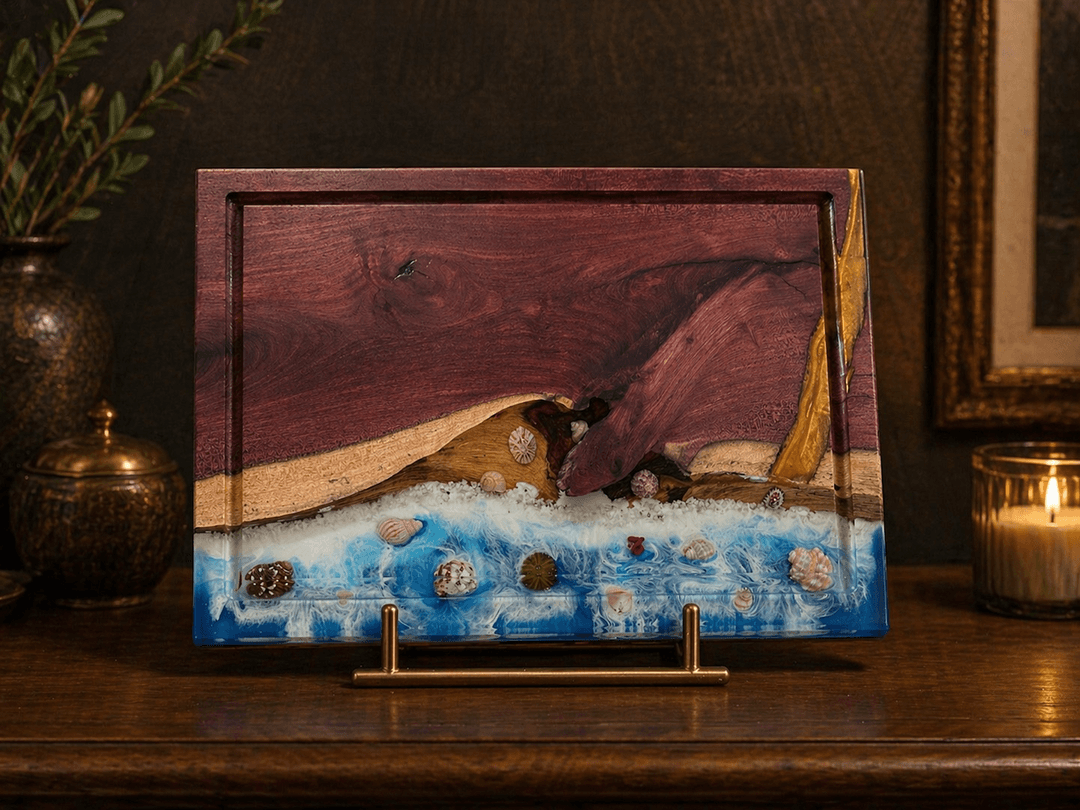
The base is Kameelhout Doring — a South African native hardwood, slow-growing and dense, with a character that imported timbers simply cannot replicate. Into this, Paulo poured layered blue epoxy to create the effect of water over sand. Embedded in the resin are seashells, a sea urchin, crushed sand, and a piece of driftwood — each one placed by hand, each one exactly where it needs to be.
The result is not a cutting board that looks like the ocean. It is a cutting board that feels like standing at the edge of one — that particular stillness that only happens at the waterline when the wind drops.
This is what separates craft from manufacture. A machine can produce a cutting board. It cannot produce that feeling.
What drives him
Paulo is not particularly interested in talking about his work in the language of art. He is a maker — practical, precise, and deeply invested in function as much as form. Every piece he produces is built to be used, to last, and to improve the space it lives in.
What he will tell you, if you ask, is that woodworking gave him back something the electrical industry never quite offered — the experience of making something with his hands that someone can hold, use, and keep for the rest of their life.
Twenty years of good work left behind walls and ceilings, invisible the moment the job was done. The pieces he makes now are different. They stay.